
•
•
•
•
•
•
1
•
•
2
•
•
3
•
•
4
•
•
5
•
•
6
•
•
7
•
•
8
•
•
9
•
•
10
•
•
11
•
•
12
•
•
13
•
•
14
•
•
15
•
•
16
•
•
17
•
•
18
•
•
19
•
•
20
•
•
21
•
•
22
•
•
23
•
•
24
•
•
25
•
•
•
•
•
•
•
•
•
•
•
1
•
•
2
•
•
3
•
•
4
•
•
5
•
•
6
•
•
7
•
•
8
•
•
9
•
•
10
•
•
11
•
•
12
•
•
13
•
•
14
•
•
15
•
•
16
•
•
17
•
•
18
•
•
19
•
•
20
•
•
21
•
•
22
•
•
23
•
•
24
•
•
25
•
•
26
•
•
27
•
•
28
•
•
29
•
•
30
•
•
•
•
•
•
•
•
•
•
•
•
1
•
•
2
•
•
3
•
•
4
•
•
5
•
•
6
•
•
7
•
•
8
•
•
9
•
•
10
•
•
11
•
•
12
•
•
13
•
•
14
•
•
15
•
•
16
•
•
•
•
•
•
•
•
•
•
1
•
•
2
•
•
3
•
•
4
•
•
5
•
•
6
•
•
7
•
•
8
•
•
9
•
•
10
•
•
11
•
•
12
•
•
13
•
•
14
•
•
15
•
•
16
•
•
•
•
•
•
•
•
1
•
•
2
•
•
3
•
•
4
•
•
5
•
•
6
•
•
7
•
•
8
•
•
9
•
•
10
•
•
11
•
•
12
•
•
13
•
•
14
•
•
15
•
•
16
•
•
•
•
PRODUCT DESIGNER
PRODUCT DESIGNER
PRODUCT DESIGNER
Gorgias Shopping Assistant: Suggested Product Questions that drive sales
Gorgias Shopping Assistant: Suggested Product Questions that drive sales
Gorgias Shopping Assistant: Suggested Product Questions that drive sales
Gorgias Shopping Assistant: Suggested Product Questions that drive sales
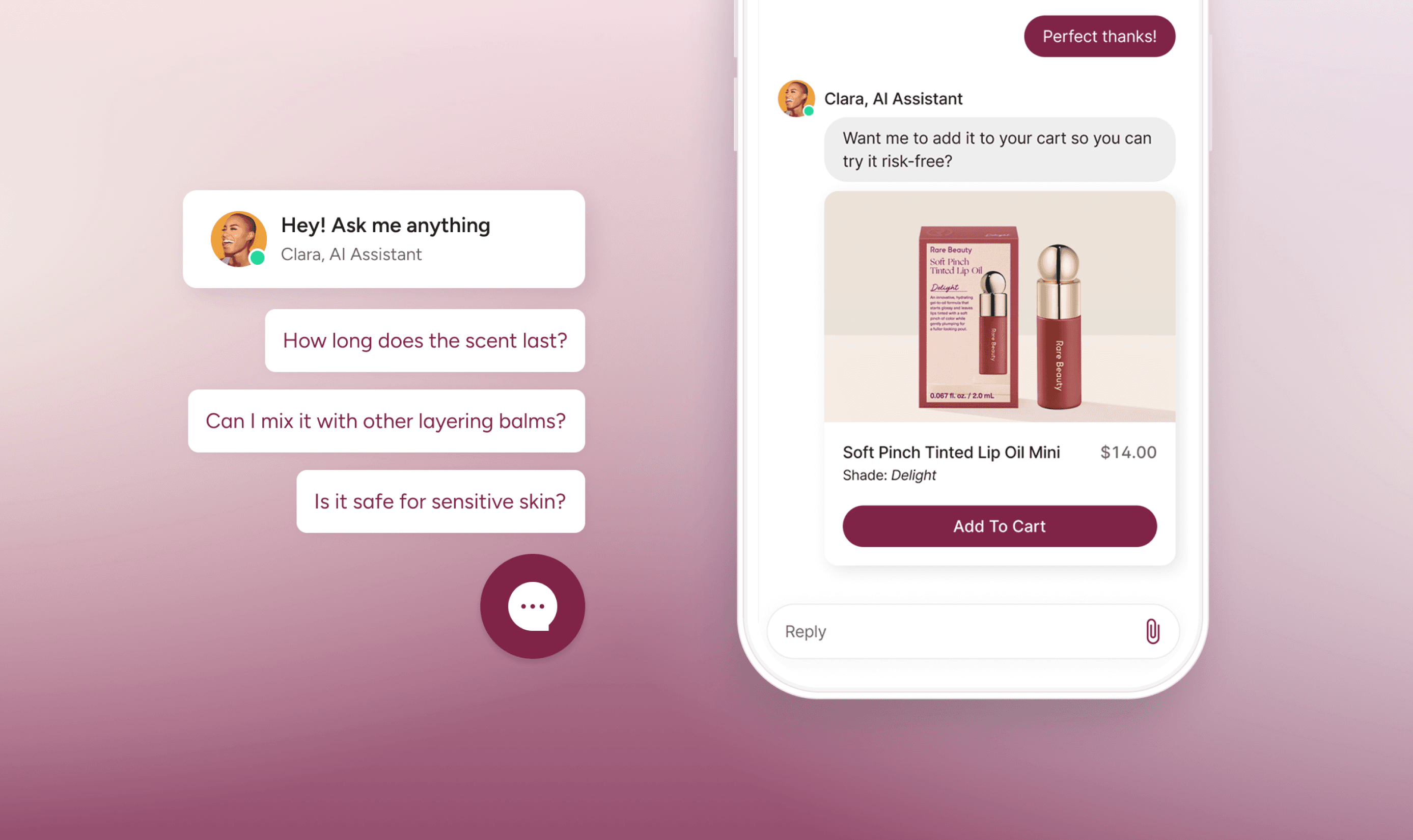
On paper, Gorgias’ AI Shopping Assistant is a game-changer: it can recommend items, compare options, and even guide shoppers through checkout from the chat widget on a brand’s website.
In practice, however, its impact is limited by low shopper engagement, with only 5% of all chat interactions coming through the assistant. To address this, in Q1 2025 we launched Suggested Product Questions — floating, contextual prompts designed to encourage shoppers to start a conversation and quickly get the information they need to make confident purchase decisions.
On paper, Gorgias’ AI Shopping Assistant is a game-changer: it can recommend items, compare options, and even guide shoppers through checkout from the chat widget on a brand’s website.
In practice, however, its impact is limited by low shopper engagement, with only 5% of all chat interactions coming through the assistant. To address this, in Q1 2025 we launched Suggested Product Questions — floating, contextual prompts designed to encourage shoppers to start a conversation and quickly get the information they need to make confident purchase decisions.
On paper, Gorgias’ AI Shopping Assistant is a game-changer: it can recommend items, compare options, and even guide shoppers through checkout from the chat widget on a brand’s website.
In practice, however, its impact is limited by low shopper engagement, with only 5% of all chat interactions coming through the assistant. To address this, in Q1 2025 we launched Suggested Product Questions — floating, contextual prompts designed to encourage shoppers to start a conversation and quickly get the information they need to make confident purchase decisions.
Impact
Impact
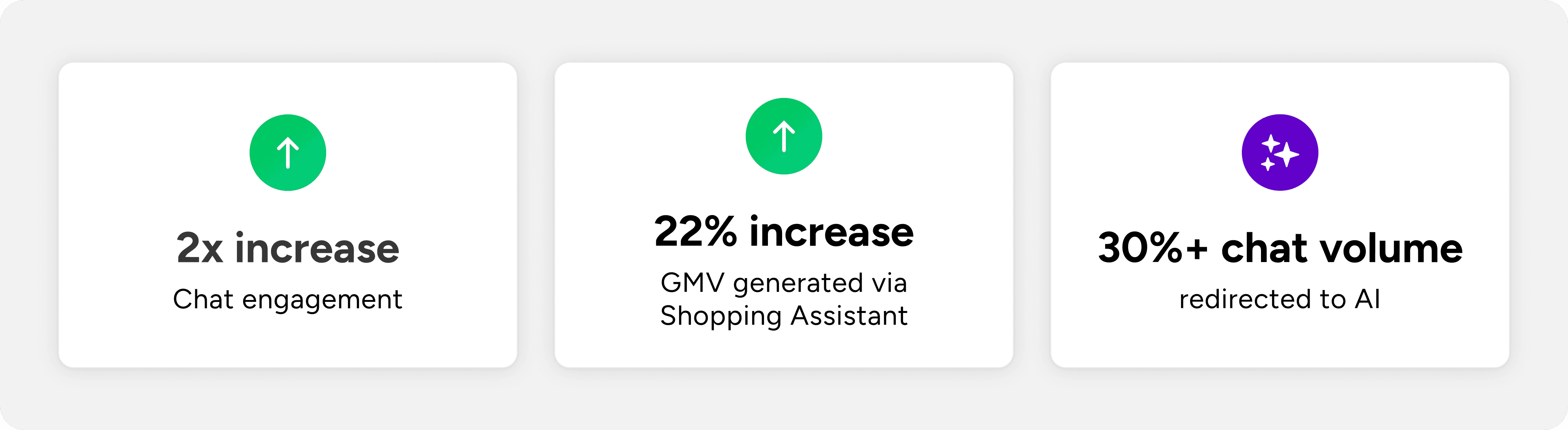
Engagement increased from 5% to 12%
Gross Merchandise Value (GMV) influenced by Shopping Assistant increased by 22%
Engagement increased from 5% to 12%
Gross Merchandise Value (GMV) influenced by Shopping Assistant increased by 22%
Engagement increased from 5% to 12%
Gross Merchandise Value (GMV) influenced by Shopping Assistant increased by 22%
Role
Role
Role
Product Designer, Gorgias (B2B SaaS)
Product Designer, Gorgias (B2B SaaS)
Product Designer, Gorgias (B2B SaaS)
Product Designer, Gorgias (B2B SaaS)
Duration
Duration
2 months (2025)
2 months (2025)
2 months (2025)
Collaborators
Collaborators
Felipe M., Product Manager
Machine Learning team
3 engineers
Felipe M., Product Manager
Machine Learning team
3 engineers
Felipe M., Product Manager
Machine Learning team
3 engineers
Impact
Engagement increased from 5% to 12%
Gross Merchandise Value (GMV) influenced by Shopping Assistant increased by 22%
A smarter path to purchase
In today’s online shopping landscape, speed and convenience are everything. Nearly 60% of consumers use AI to help them shop online in 2025, and 1 in 3 would even let AI make purchases for them.
AI Shopping Assistant helps shoppers find the right products, get answers, and make decisions without digging through pages or talking to a human. It meets them wherever they are, guiding them seamlessly from curiosity to purchase.
In today’s online shopping landscape, speed and convenience are everything. Nearly 60% of consumers use AI to help them shop online in 2025, and 1 in 3 would even let AI make purchases for them.
AI Shopping Assistant helps shoppers find the right products, get answers, and make decisions without digging through pages or talking to a human. It meets them wherever they are, guiding them seamlessly from curiosity to purchase.
In today’s online shopping landscape, speed and convenience are everything. Nearly 60% of consumers use AI to help them shop online in 2025, and 1 in 3 would even let AI make purchases for them.
AI Shopping Assistant helps shoppers find the right products, get answers, and make decisions without digging through pages or talking to a human. It meets them wherever they are, guiding them seamlessly from curiosity to purchase.
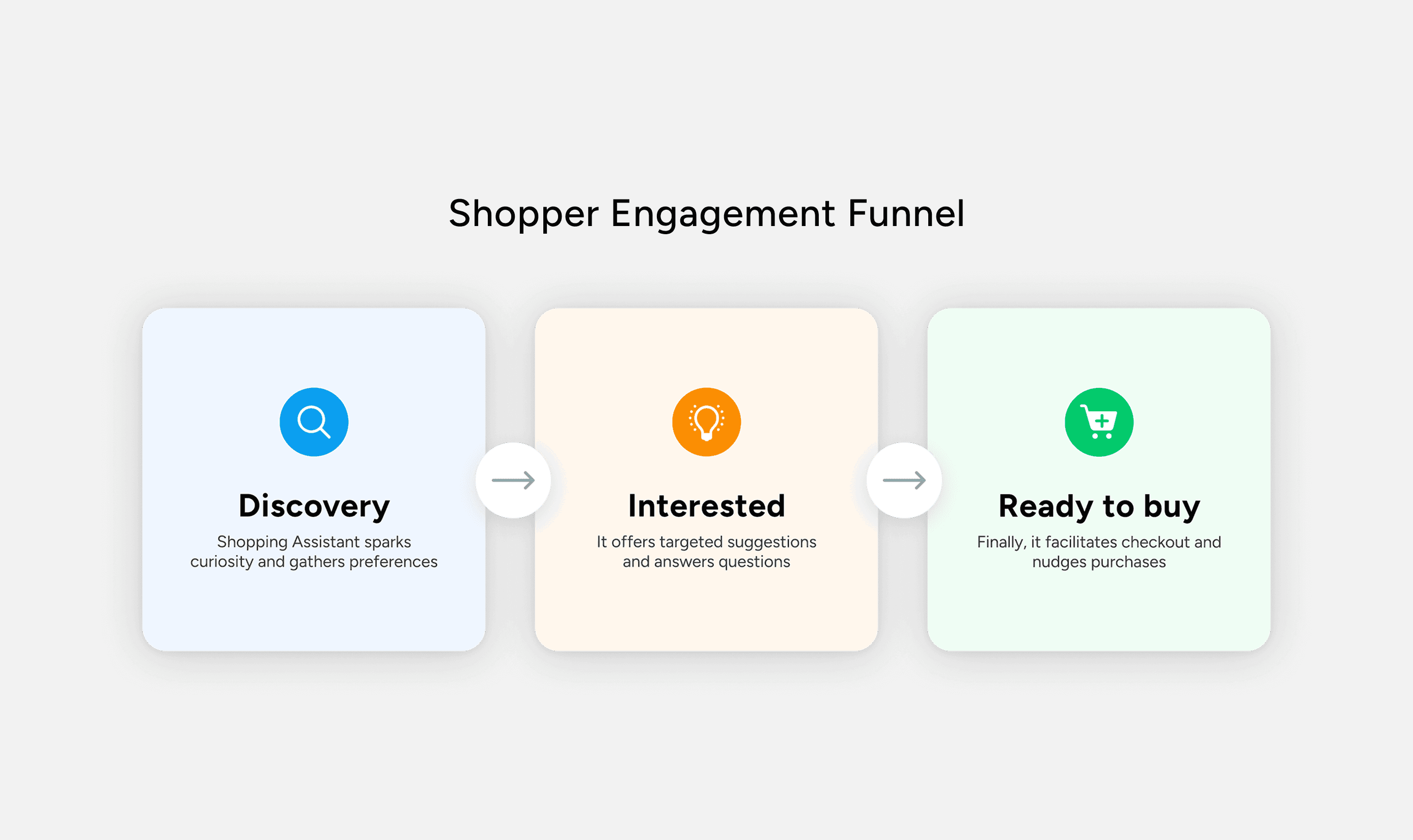
Problem: The engagement gap
The challenge wasn’t AI’s ability, but engagement. Despite its potential to guide shoppers from discovery to checkout, only 5% initiated a conversation with Shopping Assistant through chat, leaving most without ever experiencing its value.
Without engagement, even the smartest recommendations and checkout nudges can’t influence purchasing decisions, leaving untapped potential on the table.
The challenge wasn’t AI’s ability, but engagement. Despite its potential to guide shoppers from discovery to checkout, only 5% initiated a conversation with Shopping Assistant through chat, leaving most without ever experiencing its value.
Without engagement, even the smartest recommendations and checkout nudges can’t influence purchasing decisions, leaving untapped potential on the table.
The challenge wasn’t AI’s ability, but engagement. Despite its potential to guide shoppers from discovery to checkout, only 5% initiated a conversation with Shopping Assistant through chat, leaving most without ever experiencing its value.
Without engagement, even the smartest recommendations and checkout nudges can’t influence purchasing decisions, leaving untapped potential on the table.
Chat historically seen as a problem-solving channel
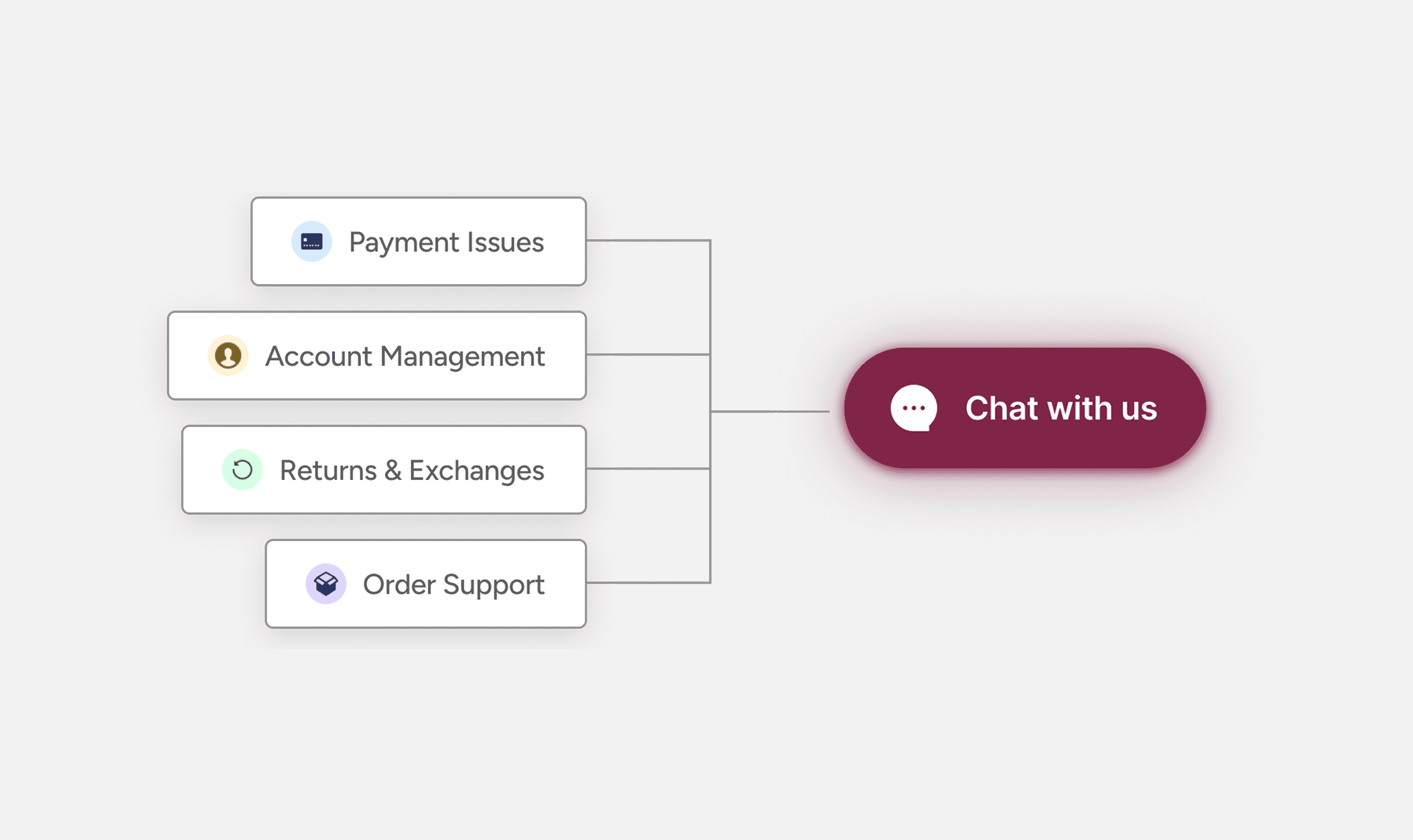
Most shoppers today who chat visit address urgent issues. Without a compelling reason to start a conversation, you may ignore the widget entirely, continuing to compare products or search for answers on your own.
Most shoppers today who chat visit address urgent issues. Without a compelling reason to start a conversation, you may ignore the widget entirely, continuing to compare products or search for answers on your own.
Most shoppers today who chat visit address urgent issues. Without a compelling reason to start a conversation, you may ignore the widget entirely, continuing to compare products or search for answers on your own.
Starting a conversation requires effort & motive
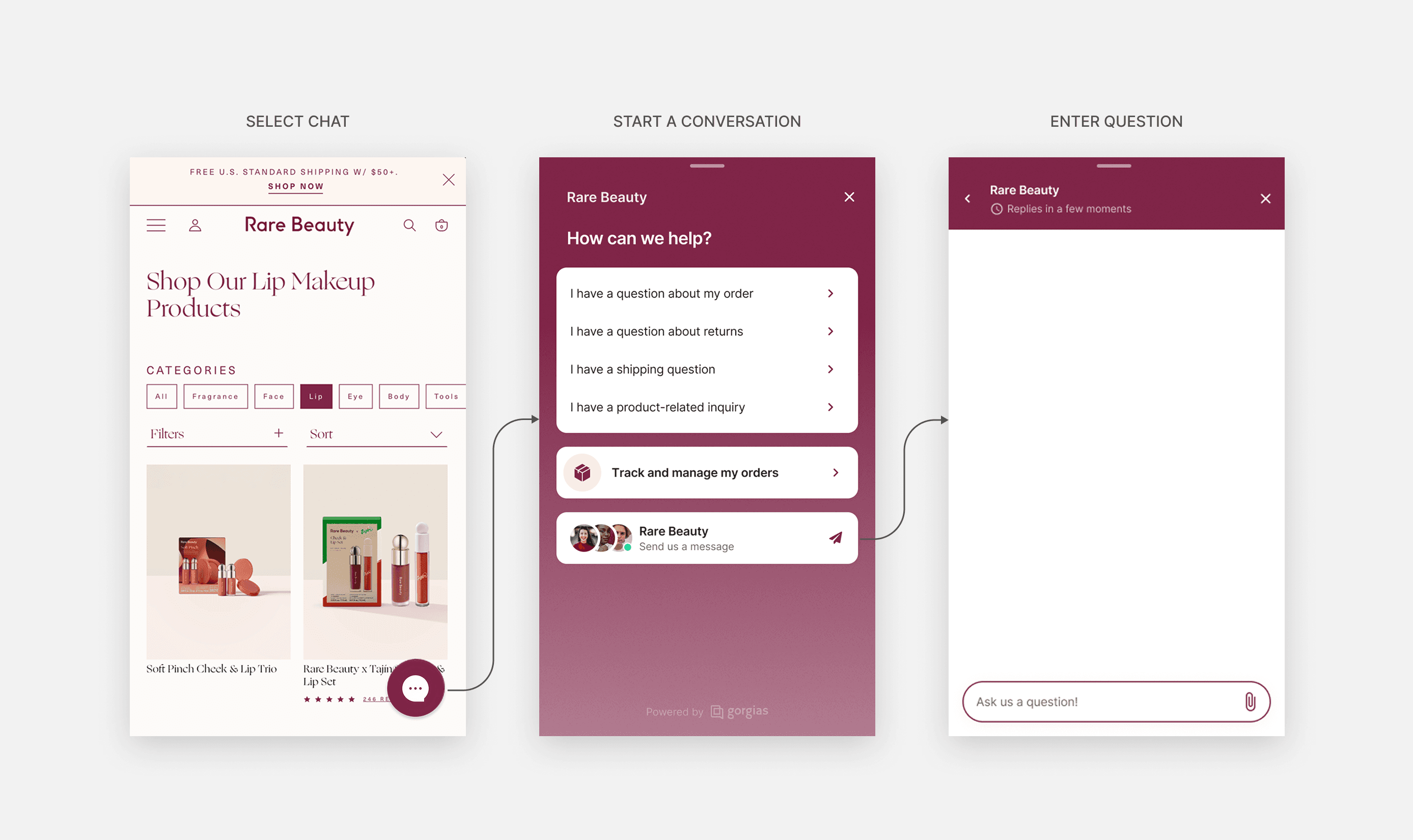
Even if you notice the chat widget, starting a conversation requires effort, and often pre-existing questions. On top of that, you might worry a bot will provide low-quality answers, or you may associate chat with intrusive sales tactics from past experiences. For casual browsers, this friction is often enough to prevent engagement altogether.
Even if you notice the chat widget, starting a conversation requires effort, and often pre-existing questions. On top of that, you might worry a bot will provide low-quality answers, or you may associate chat with intrusive sales tactics from past experiences. For casual browsers, this friction is often enough to prevent engagement altogether.
Even if you notice the chat widget, starting a conversation requires effort, and often pre-existing questions. On top of that, you might worry a bot will provide low-quality answers, or you may associate chat with intrusive sales tactics from past experiences. For casual browsers, this friction is often enough to prevent engagement altogether.
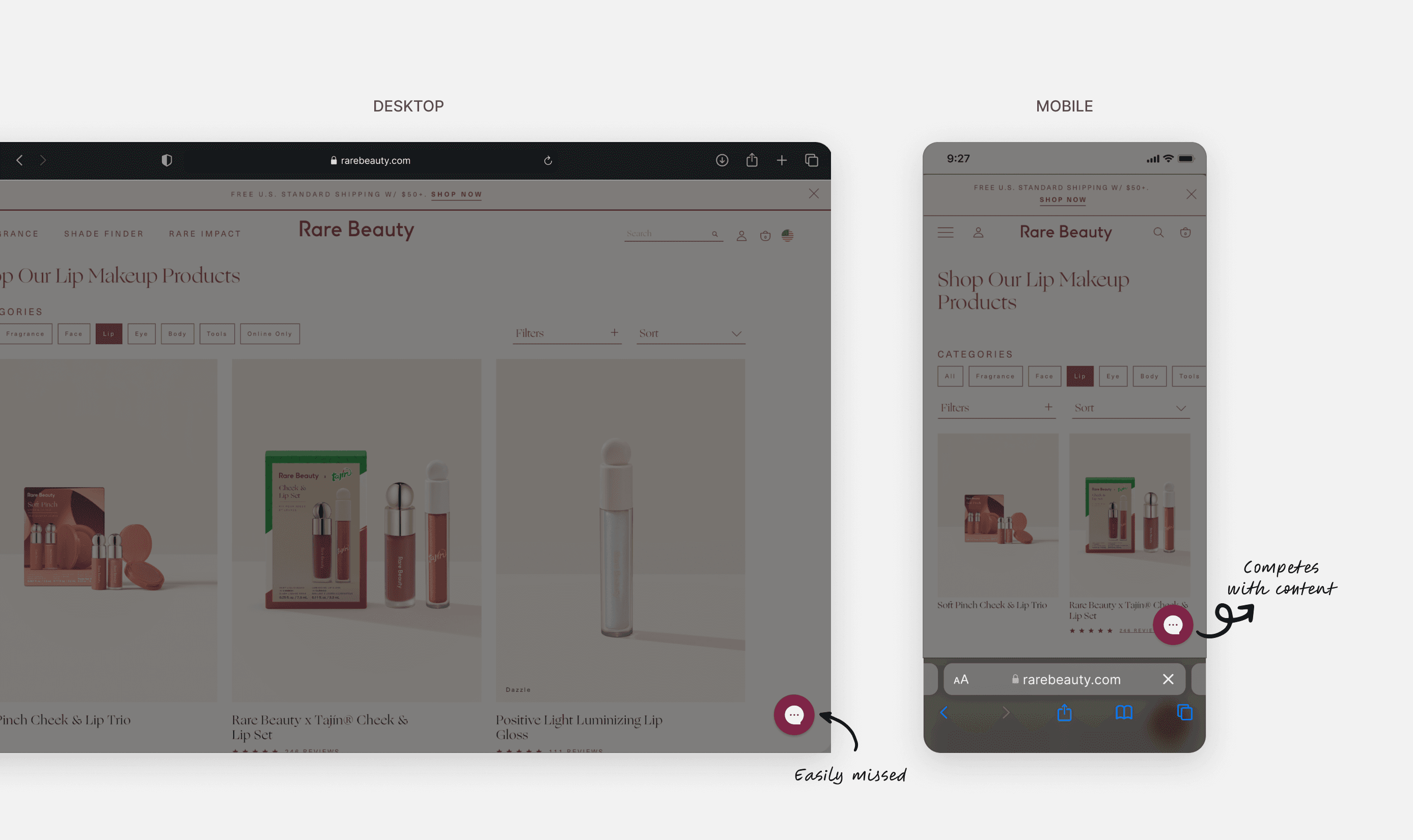
Low visibility and discoverability
Shopping Assistant is tucked away inside an icon that carries the pre-existing connotation mentioned above of "problem-solving" rather than "shopping assistance." It remains static and passive as shoppers browse while competing with the rich, engaging primary content on the page.
Shopping Assistant is tucked away inside an icon that carries the pre-existing connotation mentioned above of "problem-solving" rather than "shopping assistance." It remains static and passive as shoppers browse while competing with the rich, engaging primary content on the page.
Shopping Assistant is tucked away inside an icon that carries the pre-existing connotation mentioned above of "problem-solving" rather than "shopping assistance." It remains static and passive as shoppers browse while competing with the rich, engaging primary content on the page.
Low visibility and discoverability
Shopping Assistant is tucked away inside an icon that carries the pre-existing connotation mentioned above of "problem-solving" rather than "shopping assistance." It remains static and passive as shoppers browse while competing with the rich, engaging primary content on the page.
Solution: Suggested Product Questions that anticipate needs
Previous proactive chat features we'd launched such as Campaigns, Quick Responses, and Flows had already shown strong engagement and conversion lifts. This confirmed that prompting works, but timing is critical.
We hypothesized that floating, contextual conversation starters on product detail pages (PDPs) could engage shoppers at the moment of highest hesitation, helping them move confidently toward purchase.
Previous proactive chat features we'd launched such as Campaigns, Quick Responses, and Flows had already shown strong engagement and conversion lifts. This confirmed that prompting works, but timing is critical.
We hypothesized that floating, contextual conversation starters on product detail pages (PDPs) could engage shoppers at the moment of highest hesitation, helping them move confidently toward purchase.
Previous proactive chat features we'd launched such as Campaigns, Quick Responses, and Flows had already shown strong engagement and conversion lifts. This confirmed that prompting works, but timing is critical.
We hypothesized that floating, contextual conversation starters on product detail pages (PDPs) could engage shoppers at the moment of highest hesitation, helping them move confidently toward purchase.
Timely, non-intrusive, and highly relevant
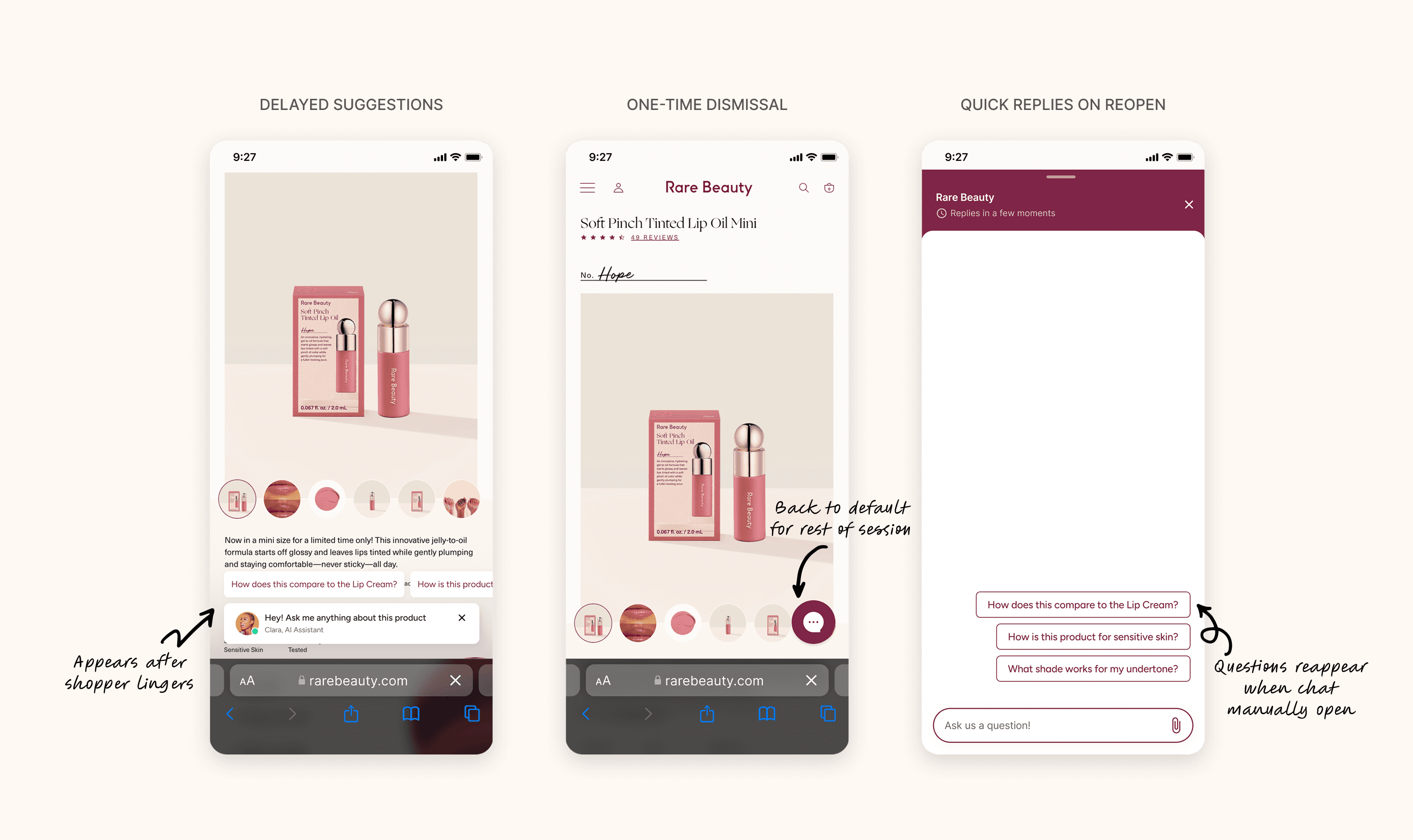
Shoppers naturally have questions on Product Detail Pages (PDPs) like Will this fit? Does it work with what I already have? Instead of interrupting the browsing experience, contextual prompts appear while the user is scrolling, making it easy to ask these questions without typing.
Questions are timed, non-intrusive, and relevant. They only surface when you linger on a page, disappear if you close them for the rest of the session, and always stay tied to the specific product you’re viewing. This makes chat feel like a natural part of shopping, not a distraction.
Shoppers naturally have questions on Product Detail Pages (PDPs) like Will this fit? Does it work with what I already have? Instead of interrupting the browsing experience, contextual prompts appear while the user is scrolling, making it easy to ask these questions without typing.
Questions are timed, non-intrusive, and relevant. They only surface when you linger on a page, disappear if you close them for the rest of the session, and always stay tied to the specific product you’re viewing. This makes chat feel like a natural part of shopping, not a distraction.
Shoppers naturally have questions on Product Detail Pages (PDPs) like Will this fit? Does it work with what I already have? Instead of interrupting the browsing experience, contextual prompts appear while the user is scrolling, making it easy to ask these questions without typing.
Questions are timed, non-intrusive, and relevant. They only surface when you linger on a page, disappear if you close them for the rest of the session, and always stay tied to the specific product you’re viewing. This makes chat feel like a natural part of shopping, not a distraction.
Questions that guide decisions
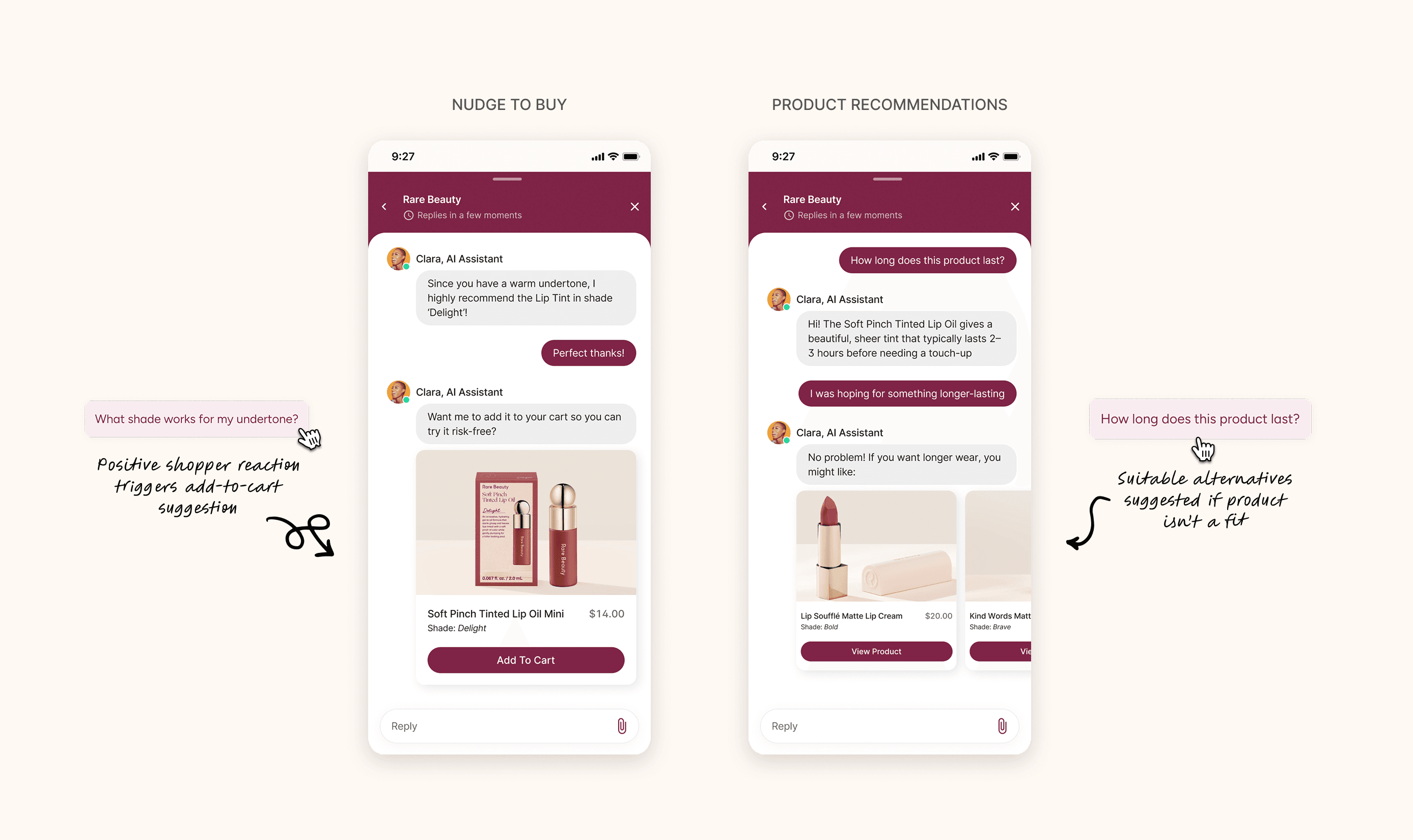
After a shopper asks a question and receives an answer, Shopping Assistant can identify their level of intent and prompt them to add the product to their cart directly within the chat, or recommend similar options.
By linking answers to next steps, Suggested Product Questions reduces hesitation and nudges high-intent shoppers toward purchase, turning helpful guidance into immediate action.
After a shopper asks a question and receives an answer, Shopping Assistant can identify their level of intent and prompt them to add the product to their cart directly within the chat, or recommend similar options.
By linking answers to next steps, Suggested Product Questions reduces hesitation and nudges high-intent shoppers toward purchase, turning helpful guidance into immediate action.
After a shopper asks a question and receives an answer, Shopping Assistant can identify their level of intent and prompt them to add the product to their cart directly within the chat, or recommend similar options.
By linking answers to next steps, Suggested Product Questions reduces hesitation and nudges high-intent shoppers toward purchase, turning helpful guidance into immediate action.
Easy setup and device-optimized
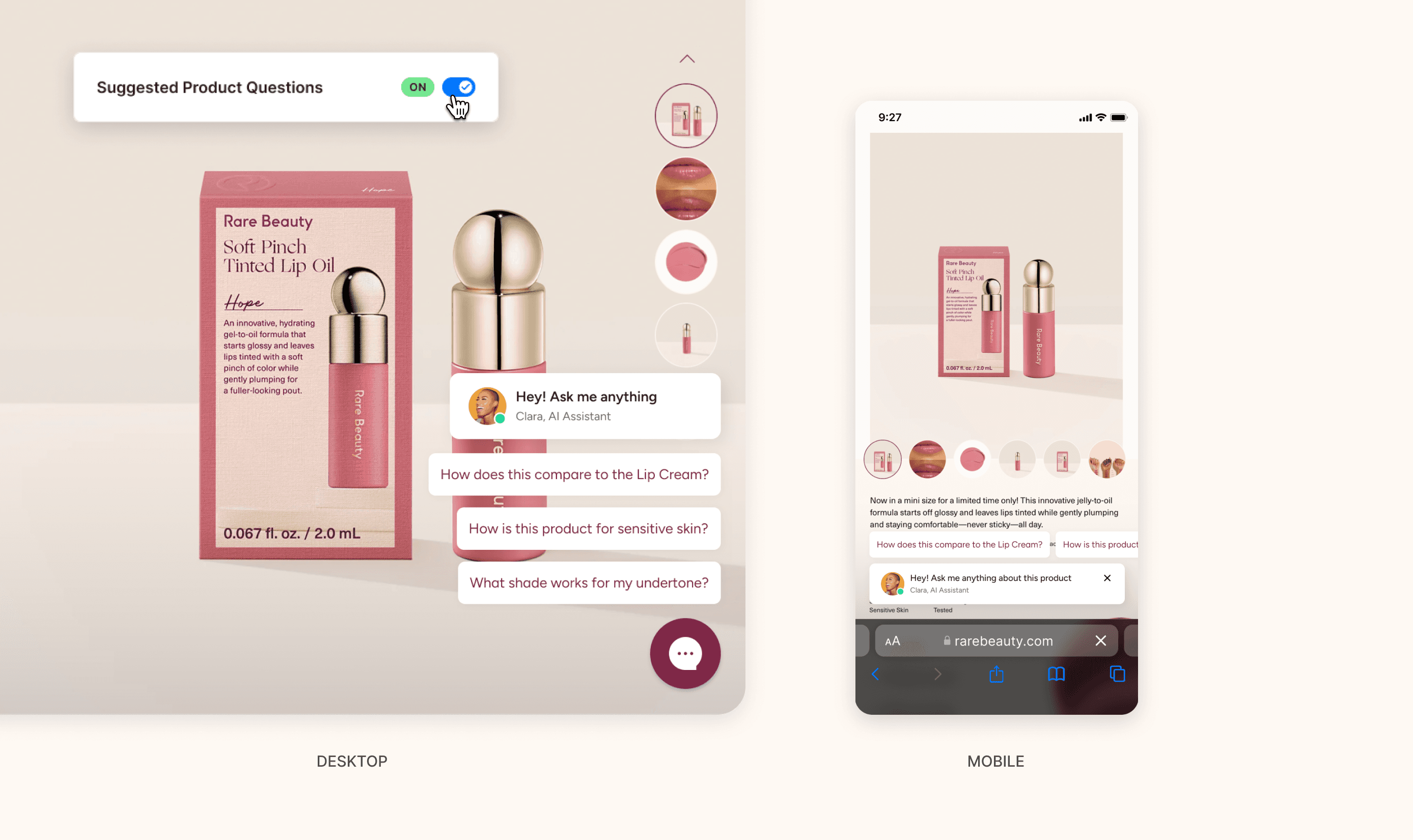
Turning on the feature is effortless for merchants with a single toggle and no heavy configuration. LLM-generated prompts pull from the merchant’s website for relevance and accuracy, match the chat's look and feel, and work seamlessly on both mobile and desktop.
Turning on the feature is effortless for merchants with a single toggle and no heavy configuration. LLM-generated prompts pull from the merchant’s website for relevance and accuracy, match the chat's look and feel, and work seamlessly on both mobile and desktop.
Turning on the feature is effortless for merchants with a single toggle and no heavy configuration. LLM-generated prompts pull from the merchant’s website for relevance and accuracy, match the chat's look and feel, and work seamlessly on both mobile and desktop.
The AI engine behind the questions
To ensure the questions would drive meaningful engagement, we needed a technical foundation capable of generating contextually relevant prompts. With the Machine Learning team, we developed a three-stage pipeline that transforms website content into actionable questions. The scraping method we used later became a standalone feature for merchants.
To ensure the questions would drive meaningful engagement, we needed a technical foundation capable of generating contextually relevant prompts. With the Machine Learning team, we developed a three-stage pipeline that transforms website content into actionable questions. The scraping method we used later became a standalone feature for merchants.
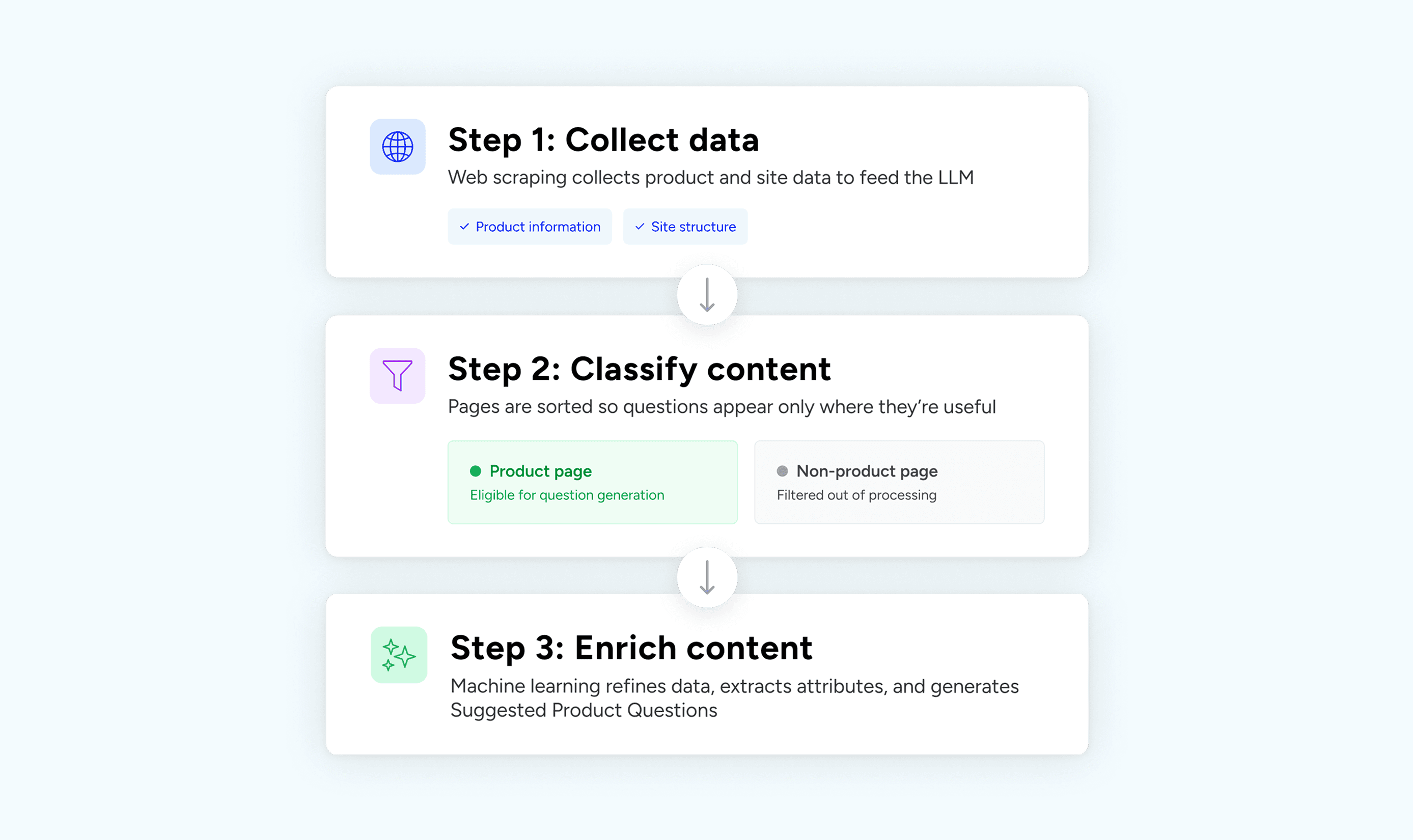
This approach ensures:
- Always current: Questions automatically update as merchants modify their content
- High quality: AI only generates questions about topics with reliable underlying data it can answer
- Better UX: Shoppers receive focused, product-specific assistance instead of generic bot responses
- Technical efficiency: The same data pipeline powers both product understanding and question generation
This approach ensures:
- Always current: Questions automatically update as merchants modify their content
- High quality: AI only generates questions about topics with reliable underlying data it can answer
- Better UX: Shoppers receive focused, product-specific assistance instead of generic bot responses
- Technical efficiency: The same data pipeline powers both product understanding and question generation
This approach ensures:
- Always current: Questions automatically update as merchants modify their content
- High quality: AI only generates questions about topics with reliable underlying data it can answer
- Better UX: Shoppers receive focused, product-specific assistance instead of generic bot responses
- Technical efficiency: The same data pipeline powers both product understanding and question generation
Validating quality through alpha testing
To validate the approach, we tested with several alpha merchants over a week to uncover patterns in question quality. We scraped their websites to generate questions and refined them based on feedback, also focusing on latency, shopper experience, and potential "banner blindness" towards the design.
Engagement and GMV impact
Learnings
Quality and relevance matter: Effective conversation starters were open, contextual, and self-contained. Prompts that led to yes/no answers or repeated page content drove little engagement.
Expanding the persona for chat: The shift engaged not just high-intent shoppers but also “light-intent” browsers, with the biggest gains on mobile. More conversations led to measurable lifts in add-to-cart and checkout initiation.
Latency: Shoppers expect immediate AI responses. Even though GMV increased, low latency caused drop-offs, with 80% of users disengaging after the first response from Shopping Assistant.
Next steps
Following the successful test, we refined the prompts by adding guardrails on question types and introducing pre-generated first responses to reduce latency to under 2 seconds. The feature is now live, with future iterations focused on enhancing relevance and personalization:
- Incorporate product reviews and shopper-specific attributes for richer context
- Use support tickets to surface highly relevant questions
- Optimize prompts based on click-through performance
- Provide an analytics dashboard for merchants to track engagement and impact
Following the successful test, we refined the prompts by adding guardrails on question types and introducing pre-generated first responses to reduce latency to under 2 seconds. The feature is now live, with future iterations focused on enhancing relevance and personalization:
- Incorporate product reviews and shopper-specific attributes for richer context
- Use support tickets to surface highly relevant questions
- Optimize prompts based on click-through performance
- Provide an analytics dashboard for merchants to track engagement and impact
Following the successful test, we refined the prompts by adding guardrails on question types and introducing pre-generated first responses to reduce latency to under 2 seconds. The feature is now live, with future iterations focused on enhancing relevance and personalization:
- Incorporate product reviews and shopper-specific attributes for richer context
- Use support tickets to surface highly relevant questions
- Optimize prompts based on click-through performance
- Provide an analytics dashboard for merchants to track engagement and impact
Learn about Shopping Assistant